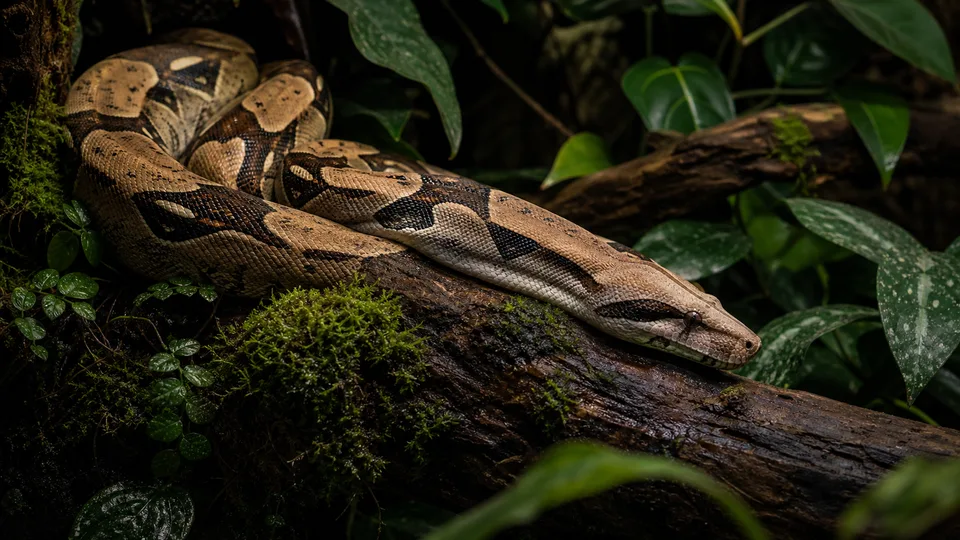
Boa constrictors are large, powerful snakes from Central and South America that can reach 6–10 ft and live 20–30 years. Adults eat appropriately sized prey every 2–4 weeks, shed every 6–12 weeks, and require warm temperatures (88–92°F hotspot), moderate humidity (50–70%), and large secure enclosures.
Quick facts
| Scientific name | Boa constrictor |
|---|---|
| Origin | Central and South America |
| Adult length | 180-300 cm |
| Adult weight | 8000-25000 g |
| Lifespan (captivity) | 20-30 years |
| Beginner-friendly | No |
| Feeding interval (adult) | 14-28 days |
| Feeding interval (juvenile) | 7-10 days |
| Shed interval (adult) | 6-12 weeks |
| Warm side | 88-92 F |
| Cool side | 75-80 F |
| Humidity (baseline) | 50-70% |
| Humidity (shedding) | 60-75% |
| Minimum enclosure | 6 × 2 × 2 ft |
Feeding boa constrictors
Adult boa constrictors should be fed one appropriately sized prey item (usually a large rat or small rabbit, around 10–15% of body weight) every 14 to 28 days. Juveniles eat smaller prey (pinky to weaned rats) every 7 to 10 days. Overfeeding is one of the most common husbandry mistakes — boas have slow metabolisms and store fat efficiently, which can lead to obesity and health issues if fed too frequently. A properly sized meal produces a noticeable but not excessive bulge that subsides within 48–72 hours.
Boa constrictors are generally reliable feeders, though they may occasionally refuse food during shedding cycles or seasonal changes. Log every feeding (ate / refused) to track patterns and avoid overfeeding — consistency over time is more important than frequency.
Shedding
Boa constrictors shed every 6 to 12 weeks as adults and every 4 to 6 weeks as juveniles. The shedding cycle begins with dull coloration and opaque blue eyes (the “blue phase”) and typically lasts 7 to 14 days. Maintain baseline humidity at 50–70%, increasing to 60–75% during shedding to prevent dehydration and stuck shed.
A complete shed should come off in one continuous piece, including eye caps. Incomplete sheds are often linked to low humidity and can usually be resolved with a humid hide or improved enclosure conditions.
Enclosure setup
An adult boa constrictor requires at least a 6 × 2 × 2 ft enclosure, though larger enclosures are strongly recommended for fully grown individuals. Provide a temperature gradient with a warm side of 88–92 °F and a cool side of 75–80 °F. Include multiple secure hides, a large water bowl, and a thermostat-controlled heat source.
Boas are semi-arboreal, especially when younger, and benefit from climbing opportunities and sturdy branches. Suitable substrates include coconut fiber, cypress mulch, or soil-based mixes that help maintain humidity — avoid pine and cedar (toxic).
Health watchlist
Common health issues in boa constrictors include respiratory infections (RI), scale rot, obesity, and mites. Signs of RI include wheezing, mucus, and open-mouth breathing. Scale rot appears as discolored or damaged belly scales, often due to excessive moisture or poor hygiene. Obesity is visible as thickened body shape and fat deposits along the spine. Mites appear as small moving black or red dots. Persistent symptoms require a reptile veterinarian.
How Snakey helps with ball python care
Snakey auto-schedules feeding intervals on a 14–28 day cycle for adults (or 7–10 days for juveniles), sends reminders when feeds are due, and tracks long-term growth trends — especially important for large species like boas. Feeding frequency, weight gain, and shed intervals are visualized together, helping detect overfeeding or husbandry issues early. Medication schedules can be logged with start and end dates, ensuring long treatment cycles are never missed.
Boa constrictor FAQ
How often should I feed an adult boa constrictor?
Adult boas should be fed one appropriately sized rat or rabbit every 14 to 28 days, depending on size and metabolism. Overfeeding is a common issue and can lead to obesity.
How often do boa constrictors shed?
Adult boas shed every 6 to 12 weeks, while juveniles shed every 4 to 6 weeks. The process typically takes around 7 to 14 days from blue phase to completion.
What enclosure size does a boa constrictor need?
Adult boas require at least a 6 × 2 × 2 ft enclosure, though larger is recommended for full-grown individuals due to their size and activity level.
What humidity does a boa constrictor need?
Maintain 50 to 70 percent humidity normally, increasing to 60 to 75 percent during shedding to prevent dehydration and incomplete sheds.
Are boa constrictors good for beginners?
Not typically — their large size, strength, and long lifespan make them better suited for intermediate to experienced keepers.