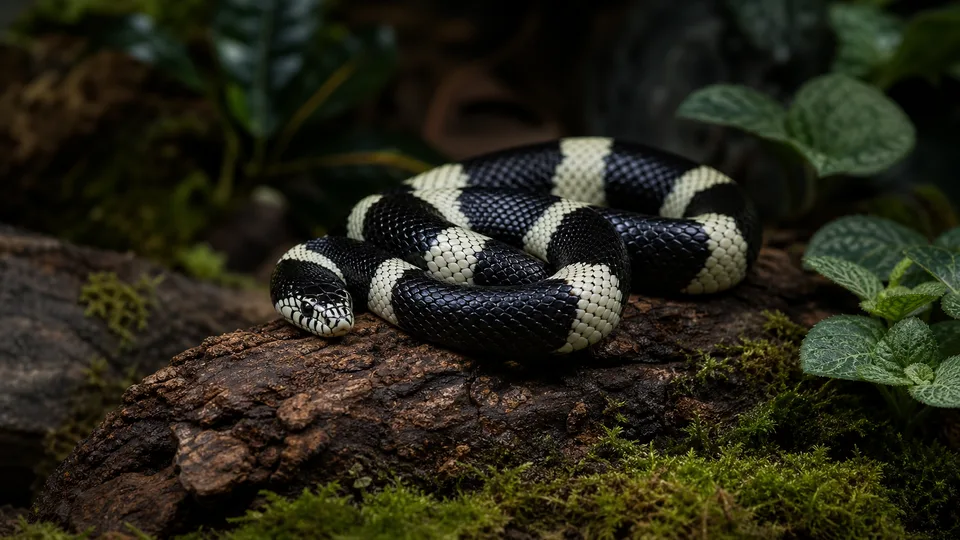
Kingsnakes (Lampropeltis spp.) are hardy, adaptable colubrids native to North and Central America. They typically reach 3–5 ft, live 15–25 years, and are excellent feeders. Adults eat one appropriately sized mouse every 7–10 days, shed every 4–8 weeks, and thrive at 85–88°F warm side, 72–78°F cool side, and 40–60% humidity.
Quick facts
| Scientific name | Lampropeltis spp. |
|---|---|
| Origin | North and Central America |
| Adult length | 90-150 cm |
| Adult weight | 500-1200 g |
| Lifespan (captivity) | 15-25 years |
| Beginner-friendly | Yes |
| Feeding interval (adult) | 7-10 days |
| Feeding interval (juvenile) | 5-7 days |
| Shed interval (adult) | 4-8 weeks |
| Warm side | 85-88 F |
| Cool side | 72-78 F |
| Humidity (baseline) | 40-60% |
| Humidity (shedding) | 50-70% |
| Minimum enclosure | 4 × 2 × 2 ft |
Feeding kingsnakes
Adult kingsnakes should be fed one appropriately sized mouse (around 10–15% of body weight) every 7 to 10 days. Juveniles eat pinky, fuzzy, or hopper mice every 5 to 7 days depending on size. Kingsnakes are known for their strong feeding response and rarely refuse food, which makes overfeeding a common mistake. A properly sized meal produces a small visible bulge that disappears within 24–48 hours.
Kingsnakes have a natural tendency toward ophiophagy (eating other snakes), which means they may strike at movement quickly and can mistake cage mates for food. For this reason, they should always be housed individually. Log every feeding (ate / refused) to monitor consistency and prevent overfeeding.
Shedding
Kingsnakes shed every 4 to 8 weeks as adults and every 3 to 5 weeks as juveniles. The shedding cycle begins with dull coloration and opaque blue eyes (the “blue phase”) and typically lasts 5 to 10 days. Maintain humidity at 40–60%, increasing to 50–70% during shedding to reduce the risk of incomplete sheds.
A healthy shed should come off in one complete piece, including eye caps. Incomplete sheds are usually caused by low humidity and can be resolved with a humid hide.
Enclosure setup
An adult kingsnake requires at least a 4 × 2 × 2 ft enclosure. Provide a temperature gradient with a warm side of 85–88 °F and a cool side of 72–78 °F. Include at least two secure hides, a water bowl, and a thermostat-controlled heat source.
Kingsnakes are active and curious, benefiting from environmental enrichment such as climbing branches, tunnels, and multiple hiding spots. Suitable substrates include aspen, coconut fiber, or paper-based bedding — avoid pine and cedar (toxic).
Health watchlist
Common kingsnake health issues include respiratory infections (RI), mites, and shedding problems. Signs of RI include wheezing, mucus, and open-mouth breathing. Mites appear as small black or red dots moving on the snake or in the water bowl. Shedding problems often present as retained skin, especially around the eyes and tail tip. Persistent symptoms should be evaluated by a reptile veterinarian.
How Snakey helps with ball python care
Snakey auto-schedules feeding intervals on a 7–10 day adult cycle (or 5–7 days for juveniles), sends reminders when feeding is due, and tracks growth trends over time. Feeding consistency — a key health indicator for kingsnakes — is clearly visualized, and shed intervals help validate enclosure conditions. Medication schedules can be logged with start and end dates to ensure treatments are completed without interruption.
Kingsnake FAQ
How often should I feed an adult kingsnake?
Adult kingsnakes should be fed one appropriately sized mouse every 7 to 10 days. They are strong feeders and rarely refuse meals.
How often do kingsnakes shed?
Adult kingsnakes shed every 4 to 8 weeks, while juveniles shed every 3 to 5 weeks. The shedding cycle usually lasts 5 to 10 days.
What enclosure size does a kingsnake need?
An adult kingsnake needs at least a 4 × 2 × 2 ft enclosure with secure hides, proper ventilation, and enrichment such as climbing structures.
What humidity does a kingsnake need?
Maintain 40 to 60 percent humidity normally, increasing to 50 to 70 percent during shedding to prevent stuck sheds.
Are kingsnakes good for beginners?
Yes — kingsnakes are considered beginner-friendly due to their hardiness, strong feeding response, and adaptability to a range of conditions.